
Whisky is an old traditional drink. Its beginnings date back to 1494. However, the quality and flavour are not comparable to today. The production process is virtually unchanged, but the technology has evolved over the centuries.
To this day, the whisky industry has not stood still! Distilleries are constantly being taken over and changed. We explain the background.
A preliminary remark on this relatively difficult subject: whisky is a contemplative drink and intended solely for our enjoyment. However, whisky producers find themselves in situations of global and local competition. The retailer stands in between and mediates between the large-scale industry and the customer.
Business Management View
When studying these pages, please put on your business glasses and try to put yourself in the shoes of board members of large industrial groups who perhaps prefer wine and beer to whisky. Imagine that you not only produce high-quality whisky, but also wine and cheap spirits. Unlike us fine spirits, most cosmopolitans prefer cheap alcohol in the form of gin and vodka or brandy and rum.
So you are the boss of a company with billions in turnover and you only calculate in US dollars or British pounds. What economic goals dominate your daily activities? What keeps you awake at night? Firstly, you have to make sure that your bosses are happy with you. Because even a company board has bosses. These are usually the investors who provide the capital. In the case of a private company such as William Grant & Sons (Glenfiddich, Balvenie), this is the Grant family. Large companies in the form of public limited companies such as Diageo or Allied Domecq are controlled by shareholders from all over the world who have bought their shares on the stock exchanges in New York or London.
Now you might ask yourself: What does this have to do with me? The big share owners up there are none of my business. They have enough money! Why do they always want more?
In Germany, saving in the form of shares or equity funds is not yet as widespread as in other countries. In Germany, life insurance and state pensions are the predominant forms of old-age provision. However, put yourself in the shoes of an American or British citizen who has invested their perhaps meagre assets in shares or equity funds. They will do everything in their power to secure and increase their retirement pension. To this end, shareholders have joined together in associations that keep an eagle eye on the actions of the boards of directors of major companies. The General Motors (GM) Pension Fund, for example, is a fierce representative of these monitoring institutions (GM - global automotive group).
- Goal 1 of these associations is a good annual return, which is calculated from the company's profit.
- Goal 2 is to increase the share price, which can usually only be achieved sustainably through company growth. In a second approximation, the company value (fixed assets, equity) determines the share price.
These two goals are also the goals of the management boards of our spirits groups. They therefore seek profit wherever they can get it and try to absorb as many companies as possible - whether small or large - for the associated growth. This is how the economic wheel turns, whether the company is called 'Deutsche Telekom AG', 'Daimler AG' or 'Diageo plc'.
The only difference between these companies is the presence of major shareholders, i.e. shareholders who hold a larger block of shares of over 25%. Major shareholders have a greater influence on company management and can also push through unpopular strategic decisions that may go against the two goals of profit and growth in the short term.
Global Impact
The spirits market is saturated in the world's major economies. In fact, it is constantly declining slightly. Profits are under pressure from competition. Nobody has unique selling points that can justify higher profits. Growth in the domestic business segment is only possible within the framework of general economic growth (1 - 3% per year) or by crowding out other drinks. Apart from the usual takeovers or in Asia and South America, where else can a large spirits company grow today?
Shareholders are demanding growth and the necessary capital is available on the market. The company began to diversify into other business areas. However, this supposedly simple growth through acquisitions also had its pitfalls. In 2001, the Canadian company 'Seagram's' overdid it with diversification and developed into a media company. They were bought out by the rival French media company Vivendi. The largest music company in the world 'Universal' (where Herbert Grönemeyer, for example, is under contract) was retained and the 'relatively small' spirits branch was sold to the big players in the industry 'Diageo' and 'Pernod-Ricard'.
You buy a company, pick out a few parts that you need and sell the rest as a whole or in pieces to the highest bidder. Anyone who has seen the film Pretty Woman with Julia Roberts and Richard Gere will have an idea of how this works. Even if it sometimes ends very cruelly for the individual employees, the small saver who wants to secure his pension with his shares or equity funds has only advantages. The free economy does not forgive mistakes in this global game of Monopoly.
But the big players are also trying to make up ground in the operational drinks sector. Both in whisky and wine. In the wine sector, the big players are managing to conclude exclusive long-term purchase agreements with private wineries. In the young wine countries (Chile, Australia, South Africa), wineries are increasingly being acquired and then further developed with the help of available capital.
In the Scotch whisky sector, the takeover battle among the big players is almost over after the mega deals of a few years ago.
But not every distillery fits in with the big players. They limit themselves to the well-known brand names and sell the smaller ones. The second tier of companies from the 'middle class' are ready to decorate their own product range with these 'leftovers'. In the shadow of the big ones, medium-sized companies are emerging that are already diversifying into gin, vodka and rum as well as whisky.
But first the very small ones helped themselves. Some independent bottlers fulfilled their dream and bought their own distilleries (Benromach, Bruichladdich, Edradour, Glengoyne).
In May 2003, four large distilleries from the 'Seagram's' break-up were still for sale. However, it is proving difficult to sell them once and for all. Due to the years of overproduction, the warehouses are full to bursting and the selling prices are correspondingly high. Who can afford these high prices? The warehouses will have to empty in the next four to five years before a buyer can be found for the buildings.
The competition continues ...
Where are the Products heading?
If the current trend is not disrupted by major political or social events, the following trends could continue and develop further.
The major spirits groups have almost completed their concentration process from food and beverage companies to pure producers of alcoholic beverages. First place is so firmly in the hands of Diageo that normal, organic growth to catch up with the big players does not promise success. Diageo has the most brands among the top 15 spirits in the world.
There is a rule in the global market. In advanced markets, there is only ever room for two big players in a market segment. In the US car market, for example, General Motors and Ford, in fast food McDonald's and Burger King, in brown sugar lemonade: Coca Cola and Pepsi, in construction machinery Caterpillar and Komatsu.
The market strategists advise: If you can't be one of the top two brands, you should try to create a separate, smaller market in which you can be one of the top two again. Of course, this also applies to the major whisky brands: Jack Daniel's and Johnnie Walker Red are neck and neck. Diageo tried to change the market and combined its Red and Black sales from 2002 onwards in order to stay ahead of the growing Jack Daniel's as Johnnie Walker Red sales declined. At the same time, an attempt was made to bring in a third whisky, J&B Rare, to keep the race open.
The battle for the second largest spirits group was fought hard with takeover battles. Pernod Ricard tried acquisitions like Seagram's and Allied tried mergers with other big players like Bacardi or Brown-Forman.
But what is happening in our beloved malt whisky market? The big players, above all Diageo, have recognised the lucrativeness and growth of malt whisky. Even if it still accounts for less than 5% of sales. Diageo serves connoisseurs with such wonderful series as The Classic Malts of Scotland or the Flora & Fauna and of course the Rare Malts Selection. All other producers are still years away from such successful series.
- Expansion of the top malt whisky brands with new premium single malts
- Example: Glenmorangie 18J, Glenfiddich 18J, Highland Park 18J
- Regular bottling of individual casks by the distilleries
- Example: Glenfarclas vintage, Ardbeg vintage, but also Bowmore Claret and Glenmorangie Tain L'Hermitage
- Bottling of high-end whiskies
- Example: Bowmore 1964, Balvenie 1966, Dalwhinnie 36J
- One problem remains in the industry. The recession in the British economy from 1980 to 1990 led to low stocks of older malt whiskies. The current malt whisky boom has also put a strain on these stocks. It will take until 2006/07 before sufficient stocks lead to a fall in prices for older malt whiskies.
- The urge of the big players to produce their own high-quality and expensive malts has led to very few single malt whisky casks being sold to independent bottlers. Sales have already ceased for the best-known distilleries. Within 15 years, this will lead to a significant shortage of inexpensive, independently bottled single malts. The larger independent bottlers have been alarmed for years and are diversifying into their own distilleries.
- Start-up or expansion of small, private companies with their own distilleries
- Example: Cooley (IRL), Ian MacLeod with Glengoyne, Speyside Distillers with Speyside/Drumguish but also Gordon & MacPhail's with Benromach or Signatory Vintage with Edradour and Murray McDavid with Bruichladdich.
- Start-ups without capital or support from the industry will find it very difficult to succeed
- Example: Glenora (CDN), Arran, Ladybank or Blackwood.
The Flipside
In any case, the end consumer can look forward to good times, as there is sufficient competition in the industry and single malt whisky is no longer seen by companies as a niche product.
One clearly visible negative trend should not be concealed. The trend towards more malt whisky is also leading to a smaller selection of good casks for bottling. The quality of the many malts sold can therefore decline. If a distillery no longer sells only 15% of its whisky as malt and the rest to the blenders, but 50% all at once, then casks that are not so good will also find their way into the bottles.
Large stocks cost interest on capital, which is why the average age of malt whiskies will also decrease. If you sell more, you need larger stocks. Multi-shift operation is slowly being introduced at all large distilleries. But most of them are still reluctant to build expensive new warehouses (with the positive exception of Macallan).
Macallan still has problems with the supply of 18-year-old malt. Glengoyne has replaced the 12-year-old with a 10-year-old. And many distilleries have placed a bottling without an age statement below their entry-level whisky (Bowmore Legend, Auchentoshan Classic). Once a brand has lost part of its reputation, it finds it difficult to regain it. Glenmorangie therefore prophylactically added a new 15-year-old above its mass-produced 10-year-old product so as not to lose its old regular customers. Glenfiddich tried to establish some new whiskies on the market at 15, 18 and 21 years old to satisfy the demand for better qualities from within the company.
Structure of the Whisky Sector
The whisky industry is generally organised along the following lines:
- Global group (Diageo, Allied Domecq, Fortune Brands, ...)
- Local production subsidiaries (UK, USA, IRL, CDN)
- Local distribution subsidiaries around the world. If the market is not big enough, local distributors are used
- At the same time, the groups not only rely on their own distribution companies, but also supply the global retail chains directly. These retail chains also include duty-free retailers, or at least what is left of them after European unification.
Alongside and around this main distribution chain, a large number of dealers and brokers have gathered, all of whom can earn a share of the big cake. 'Half a container too much Bowmore was delivered to New York? - No problem. A broker buys this half container at a low price and offers the contents for sale on pallets. 'One pallet too many in London? - No problem either. A middleman takes the pallet into his warehouse.
On the whisky streams that flow from Scotland all over the world, there are independent traders at every branching point who are happy to take surplus quantities and redistribute them. The big players save themselves costly interim storage or returns and the retailers earn a favourable purchase price. But one thing is certain. The more retailers there are in the chain, the less lucrative the price becomes for the end customer, as every middleman needs a margin to survive.
Companies approach this optimisation task of maximising profit for the manufacturer in different ways. Diageo, for example, sells its classic malts down to the delicatessen and hotel through its own distribution company. This ensures that Diageo retains the maximum added value in-house. Of course, the army of sales staff and their costs must be offset against this added value.
You can see from the examples shown here that the price of a whisky does not originate from its production. The more hands that pass it on, the more expensive it becomes.
As with all commodities in the world, there is healthy competition in the whisky trade. Ultimately, this benefits you as a customer. The number of whiskies available has increased considerably. You are spoilt for choice.
Traditional Product from modern Production
Die Anfänge

In the early stages of the industrial production of single malt whisky, the focus was on quality assurance and later on increasing efficiency. Engineers focussed on the relationship between efficiency and costs. Barley and coal in particular were optimised, as they caused the highest production costs. This resulted in the complex mashing process for optimising sugar extraction from barley and the improved conversion of starch into sugar in large-scale malting plants.
The Development

Energy consumption has been significantly reduced over the last few centuries. Initially, closed mash tuns were introduced, followed by more efficient heating systems with superheated steam instead of direct coal firing. Today, energy recovery is standard: heat exchangers extract heat from a liquid in order to return it to the production process. Insulating hot pipework and containers saves valuable energy
The use of barley and energy has been largely optimised and no longer represents a competitive advantage. In order to amortise investments, distilleries are adopting new approaches such as three-shift operation. Today, all large distilleries work around the clock all year round, with only three to six weeks off for maintenance and repairs.
Status today
Today, the focus is on optimising labour and capital. In June 1998, United Distillers (now Diageo) announced that it would be cutting hundreds of administrative jobs as part of the merger of Guinness and Grand Met. This led to numerous redundancies in administration and sales as well as staff reductions in the distilleries. Many distilleries have reduced the night shift to one person responsible for blending and the two distilling processes through extensive automation. These bottleneck machines, the mash tuns and stills, limit the capacity of the distilleries. Three-shift operation is therefore used to spread the fixed costs over as many litres of whisky as possible.

The fermentation, mashing and distilling processes are batch processes. They cause heavy soiling of the wash backs, mash tuns and stills, which is why they have to be thoroughly cleaned after each batch. Until now, this has required the use of steam lances and chemical cleaning agents. To reach places that are difficult to access, employees had to climb or crawl into the tanks.
In 1997, some distilleries equipped their fermentation vats and stills with automatic, centralised cleaning systems. These spray nozzles use a cleaning solution from centralised storage tanks and only require 5 minutes for a complete cleaning.
This centralised cleaning not only saves labour and reduces the strain on operating personnel, but also has an ecological advantage: after the cleaning liquid has been used, a 20-minute rinse with clear water takes place to ensure that all residues of the cleaning liquid are rinsed into the collection tank. The centralised feed and drainage system enables the cleaning fluid to be 100% recycled. This shows once again that the economical use of resources can also lead to environmentally friendly solutions. By the year 2000, more than 2/3 of all single malt distilleries were equipped with automatic cleaning systems.

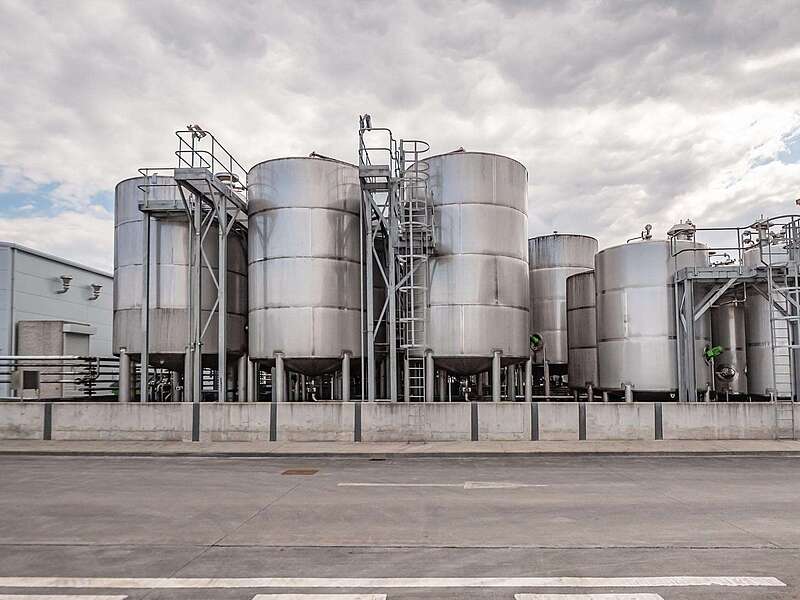
Fermentation vats were traditionally made from Oregon pine (Canadian pine), as this wood was particularly resistant to yeast fungi. Unfortunately, protecting these vats from fungal and bacterial attack required the use of extremely strong cleaning agents. With the introduction of stainless steel tanks, which were already established in beer and grain whisky production, the environment was relieved of most of these cleaning agents.
The argument that whisky from wooden wash backs tastes better than from stainless steel fermenters is not convincing. The short dwell time of 40 to 70 hours does not allow any discernible flavour transfer. In addition, the ratio of wash-back surface area to volume is much smaller than that of oak barrels during the 12-year storage period, which reduces the influence of the wash-back by a factor of more than 50,000.
In our extensive background knowledge, we have taken a close look at how whisky was made in the past and how it is made today.
To be honest, we simply like the look of the old wooden wash backs better than their modern descendants!
Visit the distillery of your choice in our distillery database.
Conclusion:
Overall, it is clear that the combination of traditional craftsmanship and modern production has led to a more efficient and environmentally friendly production of single malt whisky. Thanks to the cost savings achieved through economic and technical optimisation, we can afford our whisky in a glass!