
The mashing process is the link between malting and fermentation After looking at the production of malt in the last article, we now want to look at the further processing of the malt through to the fermentable liquid, the so-called Wort. If you are not yet familiar with the basic production method for single malt whisky, you can find out more in this video and article.
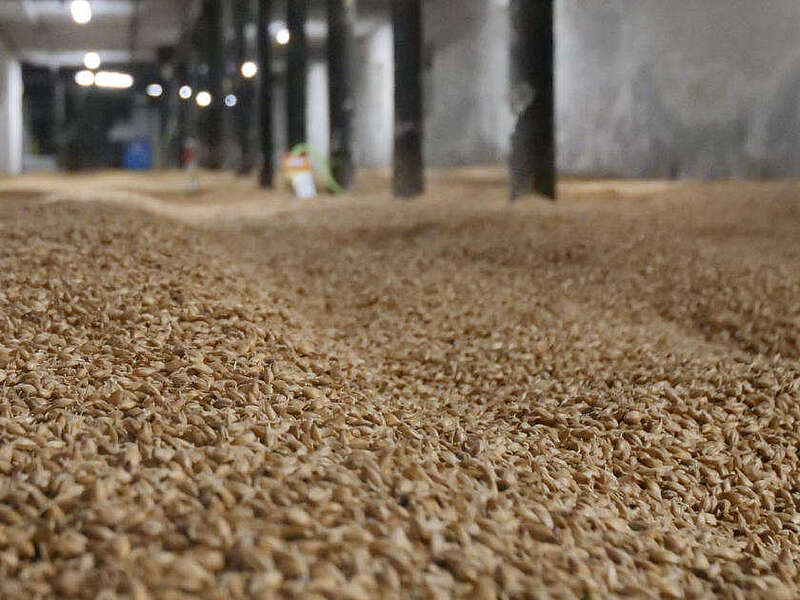
Malt storage

Germinated and dried malt can only be stored for a limited time. The shelf life of the malt depends on the season in which it is to be stored. In a dry summer, malt naturally lasts much longer than in a cold, rainy, Scottish winter. This is because dry malt is not completely dry. The residual moisture it contains and the cracked grain make it an ideal breeding ground for mould.
The path of the malt

Extraction takes place via simple taps and closed conveyors. The next station is not the malt mill, but first a mechanical sieving machine, where the last stones and unmalted hard grains are removed from the malt flow with the help of a vibrating system and gravity. It's amazing what combine harvesters can't do and how many stones are still left in the malt at the end.
Grinding to grist

Then the malt is finally ground. And what is used ... normal grain mills, as we know them from our domestic grain mills. The similarity and even the red colour is frighteningly similar to our German mills. It seems as if the designs were standardised or copied centuries ago. There are different types of mills in the whisky industry. A hammer mill is usually used for corn, wheat and rye. Hammer mills have rectangular plates made of hardened steel that are attached to an axle. The plates rotate around the axle at high speed within the grinding chamber. The hammers throw the grain towards the plates that line the mill housing, crushing the grain. In roller mills , the grain is pressed between stacked pairs of rollers, where it is crushed by the strong pressure.

The smooth rollers can rotate at different speeds to increase the pushing force. Due to the slow speeds, the grain is not heated and the associated moisture loss does not occur. Roller mills are used as standard for malted barley. Well-known brands include the 'Porteus Mill' (as used by Craigellachie) and the 'Bobby Mill' (as used by Ardbeg).
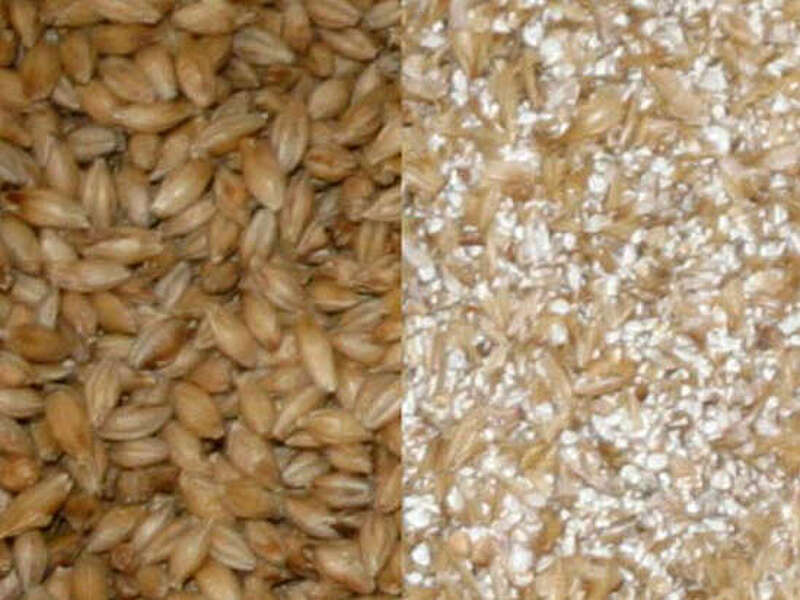
However, these mills are set with larger gaps to grind the malt. Instead of producing a fine flour, a coarse grist is produced in these roller mills. It is fine enough to break the grain completely, but not as fine as flour, so that the sieves and other equipment do not stick together in the later liquid part of the process.
The coarsely ground grain, known as grist in Scots, still consists mainly of starch. The malting process has created the enzyme amylase in the grain, which now carries out its work in a resting phase during mashing and splits the starch into various sugars.
The Mash Tun

The mash tun was invented to convert the starch into sugar and then dissolve it with water. At the very beginning of whisky production in the 18th century, the mash tun was filled with grist and boiling water was poured over it. People then had to stir the heavy mash with shovels to speed up or improve the dissolution of the sugar in the water. Initially, the mash tuns were also made of wood like the fermentation vats, but the hot water and constant stirring caused the vats to wear out quickly.

With the advent of mechanisation, the mash tuns were made from cast-iron segments (see above), which were bolted together at their edges. To simplify stirring, a mechanical, metal agitator with a central bevel gear drive was installed. This not only accelerated the sugar dissolving process, but also significantly improved its efficiency. Less sugar remained in the husks of the grain and the whisky became cheaper.

In order to optimally dissolve the malt sugar from the grist, the mash must be stirred in the mash tun for several tens of minutes. During this time, a lot of water used to evaporate and the temperature in the mash tun continued to drop with the water vapour, which further worsened the dissolving process. It was only in the last century, with rising energy prices, that almost all mash tuns were fitted with a lid made of sheet metal (e.g. copper) to limit the loss of energy.
The mashing process

Today, a multi-stage solution process has become established for the mash tuns of all distilleries. The mash tun is filled with several tonnes of grist and hot water from the company's own boiler is added via the mash mixer. The ratio of grist to water is around 1:4, resulting in a hot porridge-like mash. The first water filling is not quite as hot. The temperature of this first water is around 60 to 70 degrees Celsius. The first filling also has another special feature, which we explain at the end of this section. This first water is left in the Mash Tun for around an hour, stirring slowly, before it is pumped out.

Pumping out is much slower than filling. With modern, shallow Lauter Tuns, the sugar water can be drained through a fine filter sieve within an hour without getting any husk residue into the underback, the collecting tank. Old, high mash tuns often require extremely slow draining for up to 6 hours in order to obtain shell-free water for fermentation.
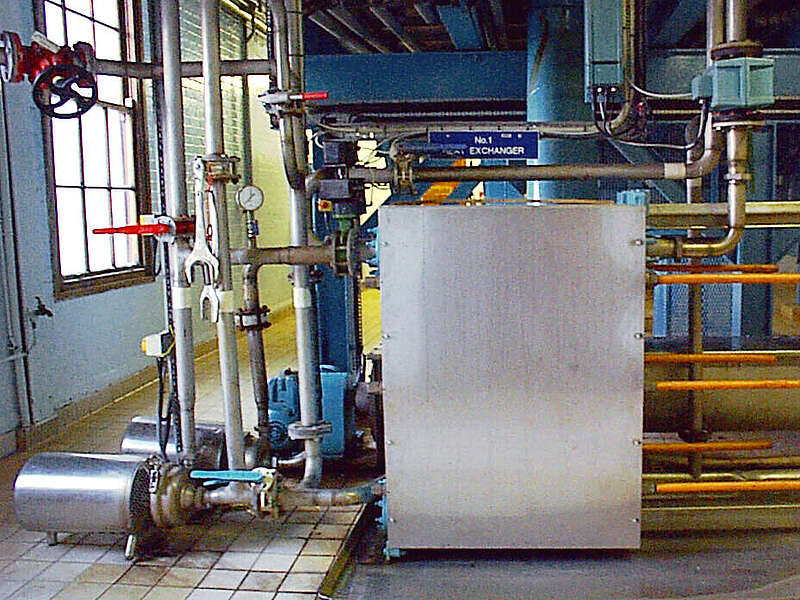
During pumping, heat is extracted from the sugar water, which is now called Wort, via a heat exchanger and cooled to around 20 degrees Celsius for later fermentation. The energy recovered in this way is used to heat the second water. As a large proportion of the sugar has already been dissolved from the grist, the second filling is heated to higher temperatures above 70 degrees Celsius to intensify the dissolving process. An even hotter third infusion at 80 to 90 degrees is almost always carried out and even in rare cases a fourth infusion is used. What all distilleries have in common is the speciality of the final water. As it contains very little sugar, it is reused as the first water for the new infusion without being reheated.
Louder Tuns

The modern lauter tuns(lauter tuns) that are being used more and more frequently are designed for speed as well as sheer size. The low height and the sieves at the bottom allow the sugar water to be drained into the underback far more quickly than is possible with old, traditional mash tuns. With these, a certain resting time must be observed after stirring so that the skins float on the sugar water and the clarified sugar water can be slowly drained downwards with a steady hand. The yield of modern Lauter Tuns has also been improved, as large, rotating arms with attached knives enable much better mixing of the grist with hot, dissolving water. Ultimately, the shape of the mash tun base is also important if you want to drain not only the sugar water but also the leftover husk after the final filling. A curved base makes it easier to dispose of the non-soluble remains of the grain.
Draff - Animal feed
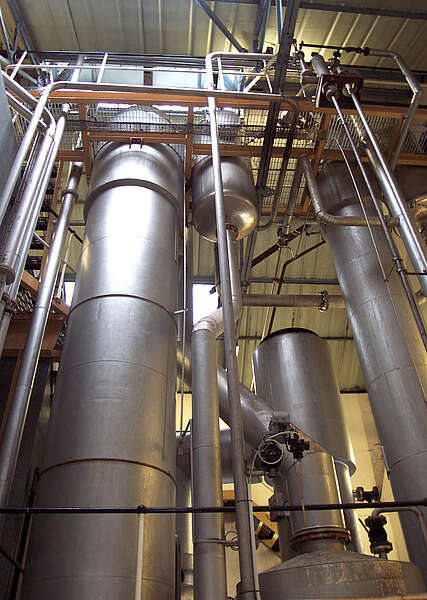
These leftover husks, which Scots call draff, contain large amounts of proteins, trace elements and minerals, which are used as concentrated feed for animal breeding. The high water content makes draff very heavy and difficult to transport. For this reason, the water is extracted in large evaporation plants. The town of Rothes, for example, has its own evaporation plant to which all the local distilleries transport their draff.

In the past, however, some distilleries (e.g. Glenfarclas and Mannochmore/Glenlossie) have taken care of their own evaporation plant. In this way, the animal feed can be directly sacked and purchased from neighbouring farmers. This partnership between farmers and distillers is centuries old and was already described by Alfred Barnard in 1887 for 35 of the distilleries he visited at the time.

After the sugar has been released from the malt through mashing, the Wort must be fermented in wash backs. The resulting "beer" can then be distilled. You can find out more about the conversion of sugar into alcohol in the following article. Read more about distilling in this article.